As the global transition toward carbon neutrality continues to accelerate, carbon capture, utilization and storage, or CCUS, for industrial tail gas is becoming a key pathway for high-carbon industries to achieve green and low-carbon transformation. Among various industrial emission sources, lime kiln tail gas contains a CO₂ concentration of 18% to 35%, far higher than the 4% to 15% typically found in coal-fired power plant flue gas, making it a highly valuable source for carbon capture and resource utilization.
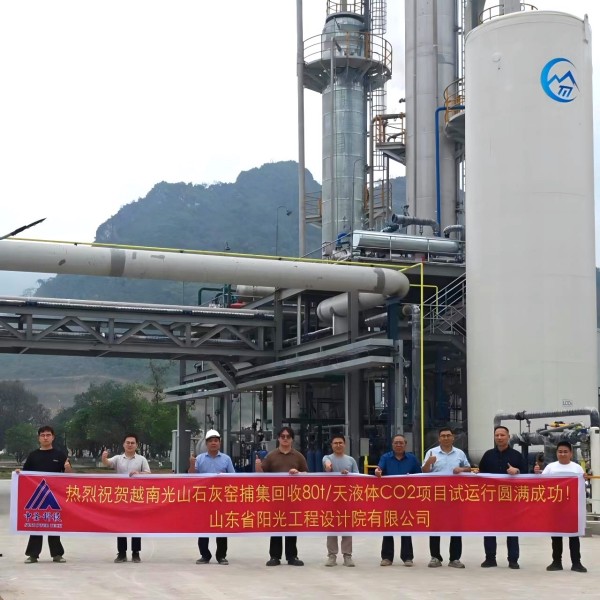
In March, the 30,000 t/a industrial-grade liquid CO₂ project for lime kiln tail gas capture and recovery, undertaken by Shandong Sunshine Engineering Design Institute Co., Ltd., a subsidiary of Sunpower, was successfully put into operation for Vietnam Quang Son CaCO₃ Trading and Production Joint Stock Company. The project marks the first full-scale overseas implementation of Chinese CCUS technology in the lime kiln industry, covering the complete process from laboratory research to industrial application and from design to delivery. It is also Vietnam’s first successful CCUS practice. The project not only helps the local enterprise address both emission reduction and resource utilization challenges, but also demonstrates China’s technical strength and engineering capabilities in carbon capture to countries along the Belt and Road.
Lime kiln tail gas is complex in composition and has distinctive process characteristics, making its capture and recovery a long-standing technical challenge in the industry. In this project, the raw gas contains approximately 18% to 22% CO₂, higher than that of coal-fired power plants. However, it also contains 10% to 15% oxygen, along with complex impurities such as sulfur dioxide, nitrogen oxides and dust. Such high-oxygen and low-partial-pressure conditions impose stringent requirements on the oxidative degradation resistance, capture efficiency and operating economics of the absorbent. Traditional monoethanolamine, or MEA, absorbents are prone to oxidative degradation in this environment, leading to increased solvent consumption, aggravated equipment corrosion and higher regeneration energy consumption.
To address these technical challenges, Sunpower worked with leading universities in China to develop a new-generation blended amine absorption technology system tailored to the project. The patented blended amine solvent used in the system introduces multiple active amine components through molecular structure optimization and formulation modification. Unlike traditional MEA, the solvent does not form stable carbamates when reacting with CO₂, and its reaction products are easier to decompose. As a result, it maintains high absorption efficiency under low-partial-pressure conditions while significantly reducing regeneration heat consumption. For the high-oxygen operating environment, the technical team added antioxidant components to the solvent formulation, effectively inhibiting peroxide formation, interrupting the degradation reaction chain and greatly extending the service life of the solvent.
At the same time, the project is equipped with an advanced lime kiln tail gas purification process. Before the raw gas enters the blended amine absorption system, the total sulfur content is controlled within 10 ppm, further ensuring the long-term stable operation of the absorbent. Through the adoption of energy cascade utilization technologies, including lean-rich liquid heat exchange optimization and regeneration tower heat integration, the project reduces unit CO₂ capture energy consumption by more than 20% compared with traditional processes. Overall steam consumption is approximately 2.0 tonnes per tonne of CO₂, electricity consumption is 230 to 240 kWh per tonne of CO₂, and chemical consumption is no more than 1 kg of pure solution per tonne of CO₂, with all key indicators reaching industry-leading levels.
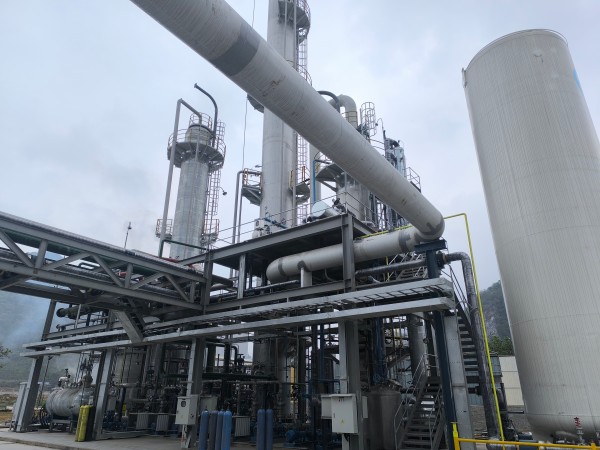
The industrial-grade liquid CO₂ produced by the project strictly complies with China’s national standard GB/T 6052—2011. The product pressure is maintained at 1.8 to 2.2 MPa, the temperature is kept between -18°C and -25°C, the concentration is no less than 99.9%, and the water dew point reaches below -65°C. The product can be widely used in fields such as welding protection and chemical synthesis. In addition, the project reserved space and technical interfaces for food-grade CO₂ processing equipment at the design stage, laying a solid foundation for the owner to extend into higher value-added product lines and achieve both emission reduction and efficiency improvement.
In the Vietnam Quang Son project, Sunpower not only provided the core process package and the full-process design covering raw gas pretreatment, capture and absorption, compression and drying, liquefaction and rectification, but also completed the commissioning of the entire system. In response to practical challenges such as overseas construction personnel’s limited understanding of specialized drawings, complex pipeline purging and pressure testing, and insufficient manpower for instrument commissioning, the technical team proactively stepped in and proposed an innovative combined solution of “regional functional division, explosive purging and long-duration purging.” The team also optimized the amine circulation control logic and adopted a commissioning strategy featuring segmented pipelines, staggered personnel deployment and cross-functional operations, ensuring the project was put into operation on schedule.
The successful implementation of the project verifies the advancement and reliability of Sunpower’s carbon capture technology and marks a key transition from pilot-stage development to industrial demonstration. As China’s first successful overseas case of industrial-grade liquid CO₂ production from lime kiln tail gas capture, the project also provides a referenceable technical pathway and practical experience for the green transformation of high-carbon industries in Southeast Asia and beyond.
At present, global carbon capture technology is continuing to evolve toward higher efficiency, lower energy consumption and lower cost, while lime kiln tail gas is demonstrating new application value in carbon resource utilization. Building on the Vietnam Quang Son project, Sunpower will continue to explore CCUS technology development and engineering application, strengthen research and practice in reducing energy consumption, improving efficiency and expanding CO₂ utilization scenarios, and continue to provide low-carbon technology solutions for countries along the Belt and Road.