Recently, the ground flare system for the PDH2 unit of Sunpower’s overseas project entered a critical installation phase. As a core component of the plant-wide safety relief and discharge system, the flare system is progressing steadily under extremely cold environmental conditions and complex technical requirements, with overall construction advancing in an orderly manner.
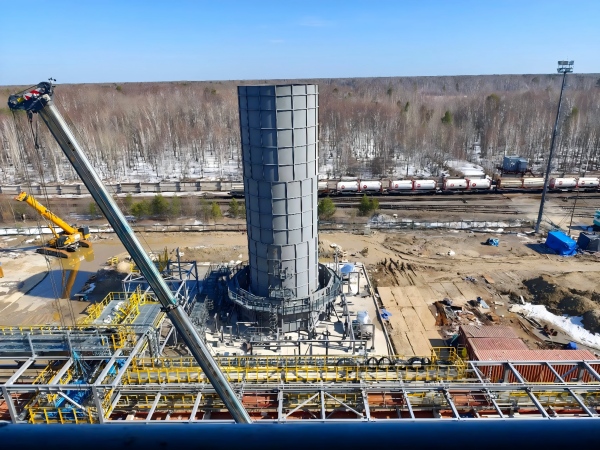
The ground flare system is designed with a processing capacity of 45 tonnes per hour and consists of five staged levels, equipped with 50 burners and 13 pilot burners. The combustion chamber has a diameter of 9.4 meters and an overall height of 30 meters. Its shell is made of SA-537 Cl.2 material, suitable for low-temperature and high-pressure operating conditions. The lining adopts ceramic fiber modules capable of withstanding temperatures above 1,200°C, ensuring structural safety under high-temperature conditions while also providing a certain degree of sound absorption and noise reduction. A steel wind wall is installed around the combustion chamber to effectively reduce the impact of crosswinds on combustion stability and minimize outward heat radiation.
Taking into account the extremely cold climate of the project location, the project has adopted air-assisted smokeless burners for the first time in its design. Compared with the traditional steam-assisted smokeless solution, this approach can effectively avoid the risk of steam freezing and failure in low-temperature environments, making it better suited to local operating conditions. In addition, the project uses a removable pilot burner design, allowing maintenance of the pilot burners and thermocouples without shutting down the unit, thereby further improving operational convenience and ensuring long-term, efficient operation.
In terms of key components, the burners are made of high-temperature-resistant 310SS material. A multi-orifice structure with small-diameter holes disperses the flare gas into multiple fine streams, increasing contact with air, improving combustion efficiency, and reducing the risk of flashback. The pilot burners are equipped with a high-energy ignition system, or HEI, and K-type armored thermocouples. They support both HEI electric ignition and FFG deflagration flame ignition, and can be operated remotely and automatically through the DCS system. To further ensure operational safety, the system is also equipped with multiple protective measures, including continuous nitrogen purging, rupture pin valve bypass, combustible gas leak alarms, and low-pressure fuel gas detection, forming a comprehensive safety protection system.
Since the project entered the on-site installation stage, construction organization has faced certain challenges due to low temperatures, snow accumulation, and other weather conditions. In response to the special operating conditions in the extremely cold region, Sunpower has worked closely with the project owner and construction contractor to continuously optimize the installation plan and steadily advance key tasks such as shell hoisting and wind wall installation. At present, the project has entered a critical installation stage, and the relevant design schemes and construction arrangements are being gradually translated into on-site results, laying the foundation for subsequent installation and system commissioning.
Going forward, Sunpower will remain committed to supporting the project with its technical expertise and project execution capabilities, steadily advancing the follow-up installation and commissioning work to ensure the safe, stable and orderly delivery of the unit.